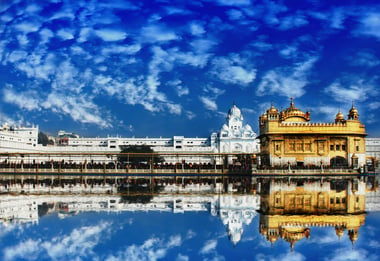
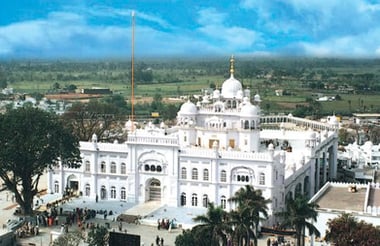
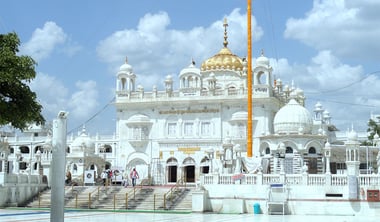
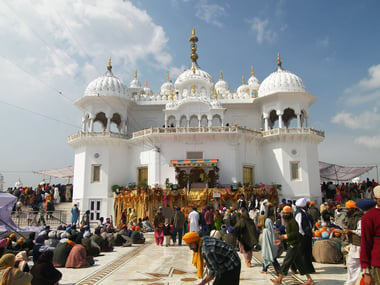
Amritsar, Punjab
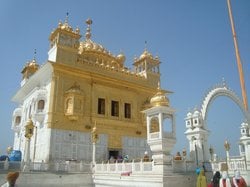
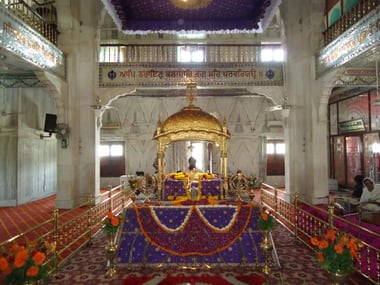
The holiest shrine in Sikhism. Founded by Guru Ram Das (fourth Guru), who excavated the sacred sarovar (Amrit Sarovar), with the temple itself built later by Guru Arjan (fifth Guru), who installed the first Adi Granth here in 1604\. Rebuilt in marble and gold-plated copper in the early 1800s under Maharaja Ranjit Singh, giving it its famous golden appearance. Uniquely has four entrances, symbolizing openness to all people regardless of caste, creed, or background, and sits at the lowest level of its surroundings, reflecting humility.
Patna, Bihar
One of the five Takhts of Sikhism, in Patna, Bihar. Marks the birthplace (1666) of Guru Gobind Singh, the tenth Guru. The site was also visited earlier by Guru Nanak and Guru Tegh Bahadur. Houses relics believed to have belonged to the young Guru Gobind Singh, including weapons and a cradle.
Nanded, Maharashtra
One of the five Takhts of Sikhism, on the banks of the Godavari river in Nanded, Maharashtra. Marks the site where Guru Gobind Singh passed away in 1708, after anointing the Guru Granth Sahib as the eternal Guru of the Sikhs (ending the line of human Gurus). "Sachkhand" means "realm of truth."
Anandpur Sahib, Punjab
Already covered above as "Takht Sri Kesgarh Sahib" — same shrine, alternate spelling. One of the five Takhts; birthplace of the Khalsa, founded by Guru Gobind Singh in 1699\.
Taran Taran, Punjab
Founded by Guru Arjan (the fifth Guru) in 1590 as a namesake for a new city — Tarn Taran means "a raft to carry one across the ocean of the world." Its sarovar (sacred pool), whose foundation stone was laid by the revered elder Sikh saint Baba Buddha, is the largest of any gurdwara in the world, even larger than the Golden Temple's. Guru Arjan established what's considered India's first dedicated home for leprosy patients here, personally bathing them in its waters, which locals still consider to have healing properties. Guru Hargobind and Guru Tegh Bahadur both later visited and preached here as well.
Patiala, Punjab
Built on the site where Guru Tegh Bahadur rested under a banyan tree in 1672 after a villager asked him to bless the plague-stricken village of Lehal. The sickness is said to have subsided, giving the site its name ("remover of suffering"). Raja Amar Singh of Patiala later laid out a memorial garden here; the current gurdwara and sarovar were completed in 1942 under Maharaja Yadavindra Singh. Devotees believe the sarovar's water has healing properties, and the shrine draws huge crowds during Basant Panchami.
San Jose, California
One of North America's largest gurdwaras serving Silicon Valley. Full langar hall, school programs, and large diwan halls across a hilltop campus. Hosts major community events and seva initiatives.
Fremont, California
Historic Bay Area gurdwara with extensive community programs. Offers langar, Punjabi classes, and a variety of services to the sangat. Convenient location with ample facilities.
Hayward, California
Active East Bay gurdwara on a multiAeacre site. Regular langar and kirtan programs with community events and classes. Serves a diverse local sangat.
El Sobrante, California
Hilltop gurdwara serving the East Bay since the 1970s. Daily divans and langar with vibrant community participation. Large campus with classrooms and kitchens.
Stockton, California
Historic gurdwara established in the early 20th century, pivotal to Sikh history in the U.S. Regular langar and community programs. Active engagement through scholarships and events.
Pacoima, California
Large SoCal gurdwara known for seva initiatives including a weekly food pantry. Regular divans and langar serving the broader community. Active volunteer programs and outreach.
Los Angeles, California
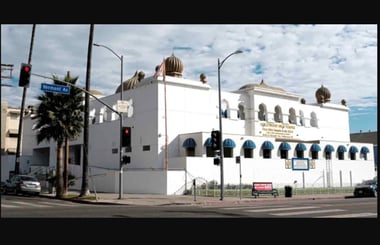
Historic Los Angeles gurdwara serving a diverse sangat. Offers regular divans, langar, and Sikh education programs. Centrally located with strong community presence.
Walnut, California
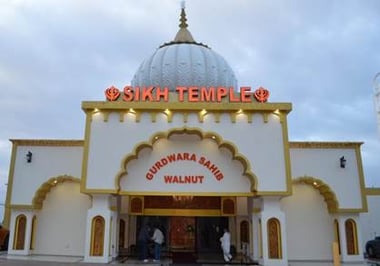
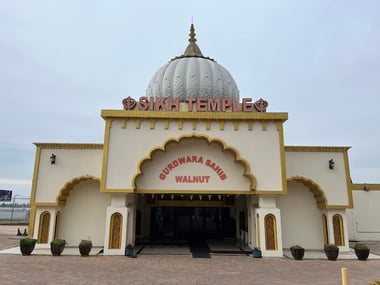
Major SoCal gurdwara convenient to LA, OC, and Inland Empire. Full langar hall, classrooms, and event spaces. Hosts regular diwans and community activities.
Riverside, California
Inland Sikh center with daily programs and active Friday/Sunday diwans. Full langar service and music classes. Serves Riverside and surrounding communities.
Buena Park, California
Southern California gurdwara offering regular diwans and langar. Community hub for families across north Orange County. Active youth and kirtan programs.
Yuba City, California
Founded in 1969, timed to Guru Nanak's 500th birth anniversary, on almond-orchard land donated by brothers Bakhtawar and Udham Singh Purewal. Before it opened, area Sikhs had to drive nearly 100 miles to the Stockton gurdwara. It was the first gurdwara in the U.S. built in Indo-Persian architectural style, and its founding led to the 1980 launch of the Yuba City Nagar Kirtan (Sikh parade), now one of the largest South Asian festivals outside India.
West Sacramento, California
A magnificent structure featuring 40 traditional domes. Opened in its current form in 1997, it serves the greater Sacramento valley with a massive 26,000 sq ft Langar hall and vibrant youth programs.
Calgary, Alberta
One of Calgary's largest and most active Gurdwaras, serving as a pillar of the Sikh community in the city's Northeast. Offers extensive youth programs and community services.
A vibrant community hub in the Westwinds/Savanna area, providing spiritual support and daily Langar for the local sangat.
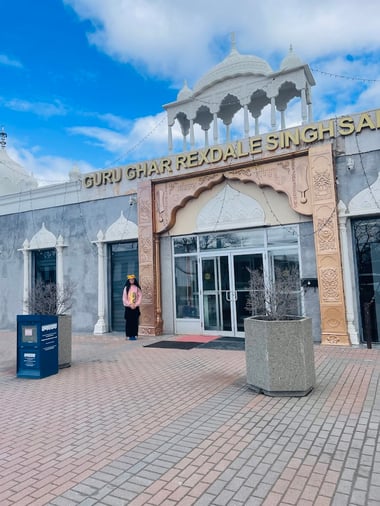
Etobicoke ON, Ontario
Religious and community center serving Rexdale area.
Vancouver BC, British Columbia
Traces to the Khalsa Diwan Society founded in 1906, which built the first Sikh gurdwara in North America at 1866 West 2nd Avenue, Vancouver, inaugurated January 1908\. The society played a central role in the Komagata Maru affair (1914), in which Canadian authorities turned away a ship of Indian (mostly Sikh) migrants under discriminatory immigration laws. The congregation moved into its current, much larger home on Ross Street in 1970, timed to Guru Nanak's 500th birth anniversary — a landmark building designed by architect Arthur Erickson (who traveled to Agra and Amritsar for inspiration) to evoke a lotus rising from water.
Surrey BC, British Columbia
Formed in 1998. One of the largest gurdwaras in North America. Serves as significant religious and cultural center for Sikh community.
Smethwick, England - Birmingham
One of the earliest and largest gurdwaras in the UK, established in 1958; capable of accommodating up to 2,000 worshippers.
Leicester, England - Leicester
Established in 1970, reflecting the growth of the Sikh population in Leicester during the 1960s-1970s.
Coventry, England - Coventry
Community-focused gurdwara with comprehensive services including health, sports, music learning, and educational programs.
Keysborough, Victoria
Kuala Lumpur, Kuala Lumpur
Eight Mile Plains, Queensland
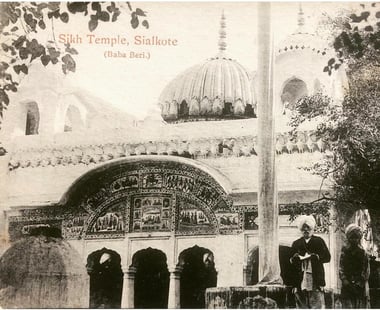
Sialkot, Punjab - Sialkot
One of the most spiritually significant sites in Sikhism. Marks the spot on the Kali Bein rivulet where Guru Nanak lived for over 14 years as a young man working as a modi (storekeeper), and where — after bathing in the rivulet one morning and disappearing for three days — he emerged having attained enlightenment, uttering "Na koi Hindu, na Musalman" ("There is no Hindu, no Muslim," meaning all are one before God). This event effectively marks the founding of Sikhism. The current gurdwara was built by Maharaja Jagatjit Singh of Kapurthala.
Converted from warehouse in 1972 serving the Ramgarhia community in Leicester.
Salmabad, Salmabad
Parque Industrial Boavista dos Pinheiros 19, 7630-033
Kuala Pilah, Negeri Sembilan
Balachaur Tahsil, Punjab
Palma, Illes Balears
Sint-Truiden, Limburg
Durban, KwaZulu-Natal
Bassersdorf, 8303 Bassersdorf
Sashima District, Ibaraki 306-0433
Gaborone, South-East
Accra, Greater Accra Region
Dagupan City, Pangasinan
Gurugram, Haryana
Kaluwanchikudy, Eastern Province
Marene, Via Pascheretto
Am Steinhugel 36a, Iserlohn
aoucu, AcoA ca
One of the five Takhts (seats of temporal authority) of Sikhism, located directly across from the Golden Temple (Harmandir Sahib) in Amritsar. Founded by Guru Hargobind in 1606 as the seat from which he asserted both spiritual and temporal (miri-piri) leadership. It is the highest political institution of the Sikhs, from which the SGPC and Sikh clergy issue edicts (hukamnamas).
Tarn Taran, Punjab
Marks the town where Guru Angad Dev, the second Guru, lived and passed away. Gurdwara Angeetha Sahib marks the site of his last rites. Gurdwara Killa Sahib and Tharah Sahib commemorate the site where Guru Amar Das (before his own guruship) carried water daily from the Beas for Guru Angad's bath. Eight of the ten Gurus are said to have visited Khadur Sahib.
Founded by Guru Amar Das, the third Guru, as a new Sikh center. Famous for the Baoli Sahib, a stepwell with 84 steps that Guru Amar Das had built; reciting Japji Sahib while descending each step is a popular devotional practice believed to bring merit.
New Delhi, Delhi
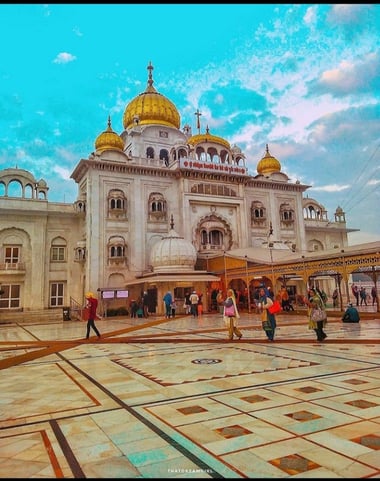
One of Delhi's most prominent gurdwaras, built around the residence of Raja Jai Singh, where Guru Har Krishan (the eighth Guru) stayed in 1664 and tended to Delhi's sick during a smallpox/cholera epidemic before succumbing himself. Known for its large sarovar, believed to have healing properties, and its striking golden dome.
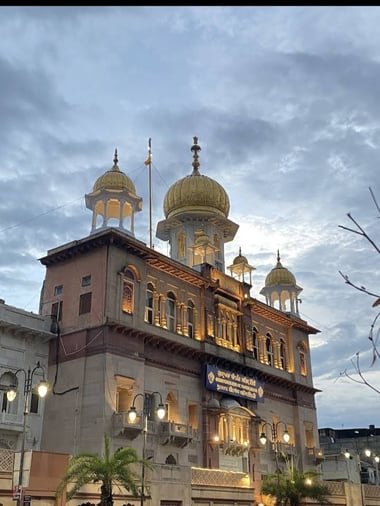
Marks the site where Bhai Lakhi Shah Vanjara cremated the body of Guru Tegh Bahadur (secretly, by burning down his own house to avoid detection) after the Guru's execution by Mughal emperor Aurangzeb in 1675 at nearby Chandni Chowk.
Located in Chandni Chowk, Delhi, marking the exact spot where Guru Tegh Bahadur was publicly executed in 1675 for refusing to convert to Islam and for defending religious freedom (including that of Kashmiri Pandits).
Marks a spot in Delhi where Guru Nanak is said to have stopped and distributed water to the thirsty during one of his travels ("piao" means a place where water is offered).
Nankana Sahib, Punjab - Nankana Sahib
Birthplace of Guru Nanak Dev Ji, the founder of Sikhism. Most sacred pilgrimage site for Sikhs. Protected Heritage Monument by Government of Punjab, Pakistan.
Lahore, Punjab - Lahore
Commemorates the martyrdom of Guru Arjan Dev Ji (5th Guru) in 1606. Built by Guru Hargobind in 1619 and expanded by Maharaja Ranjit Singh. Major landmark reflecting Lahore's cultural heritage.
Paonta Sahib, Himachal Pradesh
Marks the site of the Battle of Bhangani (1688), Guru Gobind Singh's first battle, fought against a coalition of hill rajas near Paonta Sahib.
Founded by Guru Gobind Singh on the banks of the Yamuna; he lived here for over four years (1685–88), composing much of the Dasam Granth and gathering poets and scholars at his court.
Kullu, Himachal Pradesh
In the Parvati Valley, Himachal Pradesh — associated with a visit by Guru Nanak and Bhai Mardana. Famous for its natural hot springs, which legend says burst forth at Guru Nanak's instruction to cook langar; the gurdwara sits alongside a Shiva temple, and the site is sacred to both Hindus and Sikhs.
Ropar, Punjab
Marks the site of the Battle of Chamkaur (1704), where Guru Gobind Singh and a small band of Sikhs, including his two elder sons (the Sahibzadas), made a heroic last stand against a vastly larger Mughal force.
Lohgarh, Haryana
Marks the fort ("Lohgarh" \= iron fort) built and used by Guru Gobind Singh; there is a well-known Lohgarh Sahib in Anandpur Sahib as well as a separate historical Lohgarh associated with Banda Singh Bahadur near Yamuna Nagar.
Enable location to discover gurdwaras near you